

Its My Story, AI storybook platform that turns real child photos into illustrated books
A full-stack SaaS where parents upload child photos and receive personalized illustrated storybooks, end to end, with payments, auth, and admin.
Project Overview
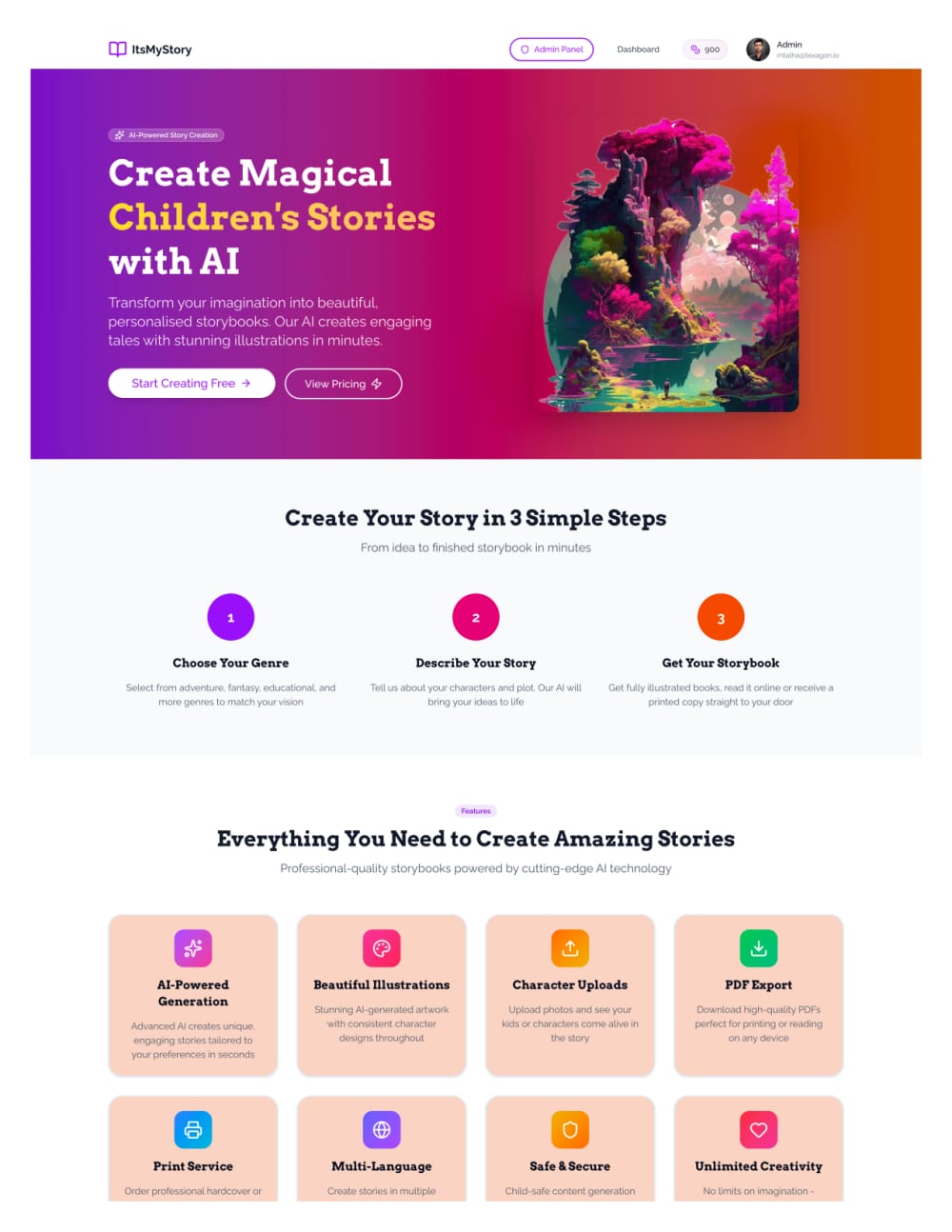
Its My Story is a SaaS that turns a real child photo into a personalized illustrated storybook. Parents upload a photo, pick a story, pay, and receive a printed book. We built the full product around the AI pipeline: web app, accounts, payments, image generation, and the internal dashboard the team uses to run the business.
Client Background
Its My Story is a GenAI startup in the personalized gifting space. The product targets parents and gift buyers who want a keepsake book that actually looks like the child. Custom illustration used to be the only route, which was slow and expensive. The founders wanted a productized version that any parent could buy in a few minutes.
The Problem
Personalized children's books carry high emotional value, but the old way of making one was bespoke illustration work. AI image generation removed the cost and time barrier, yet the surrounding product was missing. There was no clean path from a phone photo to a finished, printed book. The founders needed the full SaaS around the model: uploads, story selection, payments, order tracking, and an operator view to keep orders moving.
Challenges
- Keeping the child character visually consistent across every page of a book.
- Handling photo uploads from parents on mobile, with mixed lighting and quality.
- Wiring payments, order state, and print fulfillment into one flow without dead ends.
- Giving the operator team enough visibility to retry, override, or unblock pipeline jobs.
- Protecting child photos with sensible access and retention rules.
- Running an AI image pipeline that is reliable enough to charge real money for.
Our Approach
We started by mapping the end-to-end journey from photo upload to printed book on a doorstep. That made the moving parts clear: web, auth, payments, pipeline, storage, fulfillment, and operator tooling. We split the build into a customer side and an operator side and made the pipeline the shared spine. We picked Next.js for the customer app because it covers SEO, server rendering, and fast iteration. We picked FastAPI for the backend so the image pipeline could live close to the Python AI tooling.
What We Built
User Experience
Parents sign up, upload a photo, pick a story and style, pay, and watch the book come together. The flow is short on purpose. Each step uses plain language and shows progress, so a parent on a phone never feels lost.
Admin Operations
An internal dashboard gives the operator team a live view of orders and pipeline jobs. They can see what stage each order is in, retry failed jobs, and push books to print fulfillment. This turned daily ops from guesswork into a clear queue.
Automation
The AI image pipeline runs as a chain of steps from input photo to per-page illustration. Jobs are queued so the customer flow stays responsive while images render in the background. The system retries safely and surfaces failures to the operator dashboard.
Performance
The pipeline runs asynchronously so checkout never blocks on image generation. The Next.js front end serves quickly to first-time visitors, which matters for a gift product driven by referrals and social sharing.
Technical Architecture
The system has a Next.js web app for parents, a FastAPI backend for orchestration, an AI image pipeline talking to the OpenAI API, a payments and auth layer, storage for photos and generated pages, and an operator dashboard sitting on the same backend.
Key Decisions
- Next.js for the customer app. We wanted a public-facing site that ranks, renders fast, and is easy to iterate on. The tradeoff is a Node front end alongside a Python backend, which we accepted for the developer experience.
- FastAPI for the backend. The AI work is Python heavy, so keeping the pipeline and API in one ecosystem reduced glue code. We gave up the option of a single-language stack.
- Async job pipeline instead of inline generation. The checkout flow stays snappy and the pipeline can take the time it needs. The tradeoff is the extra moving parts of a queue and job state.
- Build an operator dashboard from day one. It is more work up front, but it removes the need for engineers to babysit orders. The tradeoff was scope, not complexity.
Results
The platform is live and serving real orders from parents. The flow runs end to end: account, upload, story choice, payment, AI generation, preview, and print fulfillment. The operator team works from a clear queue instead of digging through logs. The pipeline produces character-consistent pages across a book, which is the part that makes the product worth buying.
Project Highlights
- A working AI image pipeline that keeps a child character consistent across pages.
- Full SaaS shell around the model: auth, payments, orders, and re-orders.
- Operator dashboard for live order and pipeline visibility.
- Print fulfillment integration that closes the loop from upload to delivery.
- Production architecture on Next.js and FastAPI, ready to extend.
Screens and User Flows
The core flow is short and linear, so parents reach the paid step quickly and then watch the book assemble itself. The operator team picks up from there inside the dashboard.
Future Growth Opportunities
- More story templates and age bands, reusing the same pipeline.
- Sibling and family books that handle multiple characters on the same page.
- Gift flows, including gift codes and scheduled delivery.
- A creator or partner program where schools and brands can co-brand books.
- Localization into more languages, since the text and pipeline are decoupled.
- A mobile-first uploader with guided lighting and pose tips to improve input photos.
Want one of these for your team?
45-min call, fixed quote in 72 hours, code in production by week 4.
Core MVP shipped to production by week 4.
or send a 2-min Loom →or email hello@obsidiancode.io