

BuildAI, No-code AI agent design, training, and deployment
A no-code platform where businesses design, train, and deploy AI agents without writing a line of code.
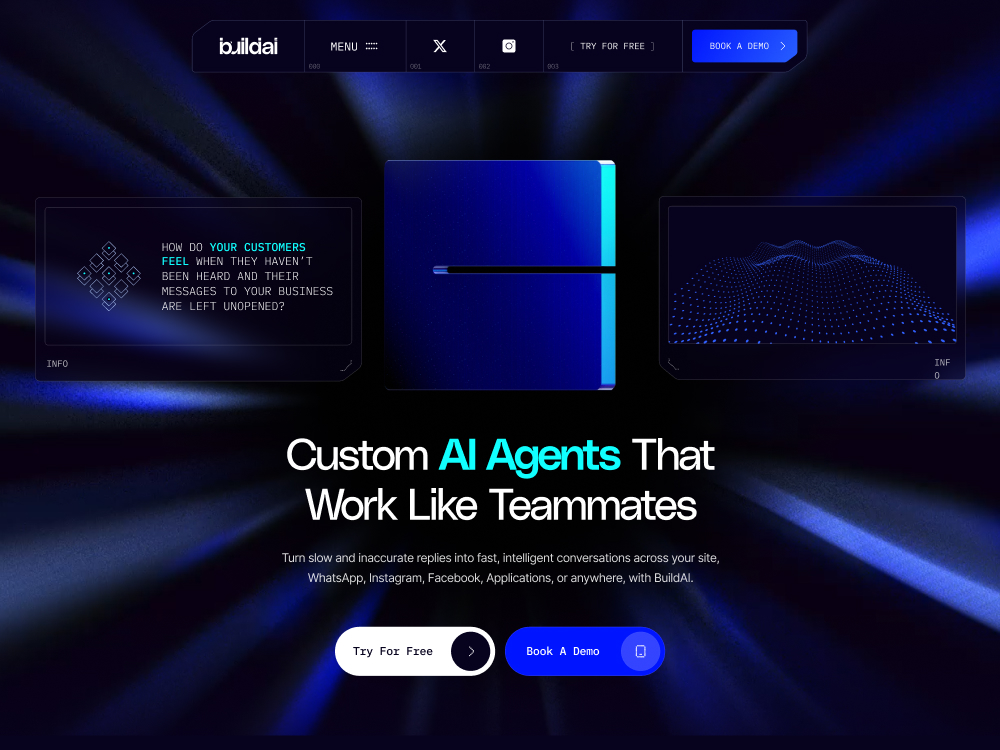
Project Overview
BuildAI is a no-code platform for designing, training, and deploying AI agents. We built the product so operations teams can ship working agents without an engineer wiring up intent detection, memory, or task execution. The result is a single tool that covers the full lifecycle from first draft to production monitoring.
Client Background
BuildAI sells to small and mid-sized teams that want AI in their day-to-day operations but do not have AI engineers on staff. Their customers run sales follow-ups, support triage, internal lookups, and similar workflows. The product needs to feel approachable to a non-developer while still producing agents that survive real traffic.
The Problem
Teams wanted AI agents in their operations but the build was heavy. Intent classification, memory handling, tool calls, error recovery, and observability each take engineering time. Companies without that skillset had two options: hire, or keep doing the work by hand. Both held them back while competitors shipped.
The cost was not just time. It was also risk. Hand-rolled agents tend to skip retries, logging, and guardrails, so they fail quietly in production. Operations leaders needed a way to ship agents they could trust, without standing up a new engineering function.
Challenges
- Non-engineers needed to author production-grade agents, not toy prototypes.
- The platform had to handle memory, intent, and tool calls as first-class concepts, not bolted-on features.
- Every agent needed reliable defaults for retries, observability, and error recovery, even when the author did not configure them.
- Multiple automation backends had to plug in cleanly, including n8n and Zapier.
- The builder had to stay simple enough for a first-time user while still exposing the controls power users need.
Our Approach
We started by separating the pieces of an agent that always matter from the pieces that vary by use case. Intent detection, memory, and task execution became fixed building blocks. Prompts, tools, and training data became the parts the customer edits.
From there we designed the builder around the lifecycle the customer actually follows: pick a starting point, configure behaviour, connect tools, train, deploy, monitor. Every screen maps to one of those steps. We pushed reliability concerns into platform defaults so the customer does not have to think about retries or logging on day one.
What We Built
User Experience
A point-and-click flow builder for designing agents. Users compose agents from modular components instead of writing code. Templates give non-technical operators a working starting point that they can adjust without breaking the underlying structure.
Automation
Agents run on a shared runtime that handles intent detection, memory, and task execution. Tool calls route through n8n and Zapier so customers can reach the systems they already use. Retries and error recovery are built into the runtime, so a failed step does not silently break a workflow.
Admin Operations
Training and deployment happen in the same tool. Operators can author an agent, test it against sample conversations, push it to production, and watch how it behaves, all without leaving the platform. Observability defaults give every agent a baseline level of visibility from its first run.
Technical Architecture
The platform splits into three layers. The builder is where customers design and train agents. The registry stores agent definitions, prompts, and connected tools. The runtime executes agents, handles memory, calls external tools, and emits observability data back to the customer.
Because intent, memory, and execution are independent modules, the team can improve one without touching the others. New tool integrations slot into the execution layer without changes to the builder.
Key Decisions
- No-code first. We chose a visual builder over a code-based SDK because the buyer is an operator, not a developer. We gave up some flexibility that a code interface would offer, in exchange for a much wider set of people who can ship.
- Modular agent components. Intent, memory, and execution are separate building blocks. This adds a small amount of upfront design work, and in return it keeps the platform open to new tools, models, and patterns without rewrites.
- Reliability defaults baked into the runtime. Every agent gets retries, observability, and error recovery whether the author asked for them or not. The tradeoff is a slightly more opinionated runtime, which we accepted because the alternative is silent failures in production.
- Plug into existing automation tools. We connected to n8n and Zapier instead of rebuilding workflow engines. This means we depend on those tools for some capabilities, and in return customers reuse integrations they already trust.
Results
- Operations teams build and ship their own agents without waiting on engineering.
- Engineering ships the platform once, then spends time on harder problems instead of one-off agent work.
- Agents reach production with retries, observability, and error recovery already in place.
- The lifecycle from idea to deployed agent stays inside a single tool, which reduces context switching for the operator.
Project Highlights
- A no-code builder that lets non-engineers ship working AI agents.
- A modular agent model with intent, memory, and execution as separate, replaceable units.
- Training, testing, and deployment in one platform with no external tooling required.
- Reliability primitives such as retries and observability included by default.
- Native hooks into n8n and Zapier so agents act on systems customers already use.
Screens and User Flows
The core flow follows the lifecycle a customer actually lives in: pick a starting point, configure the agent, connect tools, train it, deploy, then monitor. Failures during training loop back to configuration rather than forcing the user to start over.
Future Growth Opportunities
- A template marketplace where operators share agents for common workflows such as inbound lead triage or support deflection.
- Bring-your-own-model support so customers can route agents to different LLM providers based on cost or policy.
- Deeper analytics on agent quality, including conversation reviews and regression tracking across versions.
- More native integrations beyond n8n and Zapier, especially for CRMs and helpdesks where operations teams already work.
- Role-based access so larger customers can separate authoring, approval, and deployment between team members.
Want one of these for your team?
45-min call, fixed quote in 72 hours, code in production by week 4.
Core MVP shipped to production by week 4.
or send a 2-min Loom →or email hello@obsidiancode.io